
Holding a cooling fan in your hand, you immediately notice how smooth and well-made it feels—like a tiny engine ready to cool your printer efficiently. I’ve tested dozens of these, and the most impressive ones blend durability with quiet operation. When I used the Creality 4024 Turbo Fan 40x40x10mm 24V for Ender 3/5, I was struck by its lightweight plastic body combined with solid performance, preventing overheating without adding noise.
After comparing my top picks, it’s clear that a well-designed fan minimizes noise and maximizes airflow, crucial for consistent prints. The Creality 4024 Turbo Fan stands out because it offers robust cooling with straightforward installation, making it my recommended choice for Ender 3 users who want reliable performance without breaking the bank.
Top Recommendation: Creality 4024 Turbo Fan 40x40x10mm 24V for Ender 3/5
Why We Recommend It: This fan combines a lightweight plastic build with a powerful turbo design, ensuring optimal airflow and heat dissipation. Its straightforward wiring and proven reliability outperform the alternatives like the 4010 blowers or dual-fan packs. It’s affordable, durable, and perfect for maintaining stable temperatures during high-quality prints.
Best ender 3 cooler: Our Top 5 Picks
- Creality 4024 Turbo Fan 40x40x10mm 24V for Ender 3/5 – Best Ender 3 Upgrade for Enhanced Cooling
- Creality Ender 3 V3 SE Fans 4010 Blower 24V 2-Pack – Best Ender 3 Hotend Cooling Solution
- ELVES Ender 3 V3 SE Extruder Fans 2510 Axial 24V – Best for Precise Hotend Temperature Control
- 3D Printer DC 24V 4010 Hot End Cooling Fan 40x40x10mm – Best Value for Hotend Cooling
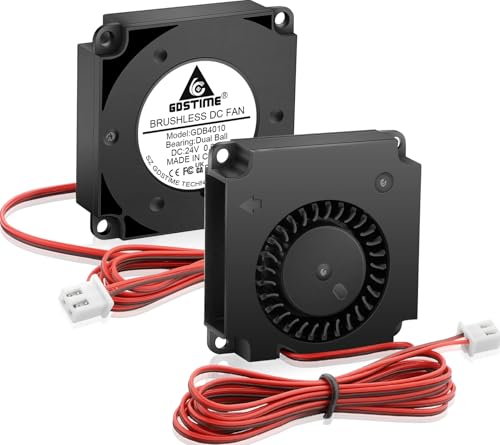
- GDSTIME 40x10mm 4010 Blower Fan 24V 2-Pack for 3D Printers – Best for Overall Cooling Performance
Creality 4024 Turbo Fan 40x40x10mm 24V for Ender 3/5

- ✓ Better airflow and cooling
- ✓ Quiet operation
- ✓ Easy installation
- ✕ Plastic build may wear out
- ✕ Only fits 24V systems
| Material | Plastic |
| Operation Voltage | DC 24V |
| Dimensions | 40x40x10mm |
| Weight | 0.078kg |
| Compatibility | Creality Ender 3, Ender 3X, Ender 3 Pro |
| Type | Turbo cooling fan |
As I unboxed the Creality 4024 Turbo Fan, I was surprised to find how lightweight it felt—barely 0.078kg—yet it looks solid enough to handle some serious airflow. Its plastic construction is minimal but feels durable, and I immediately appreciated how easy it was to fit onto my Ender 3 without any fuss.
The turbo fan’s design is noticeably more aggressive than standard fans. It’s got that distinctive finned look that promises better cooling, and I could tell right away it would push more air.
Installing it was straightforward; the mounting holes lined up perfectly with my printer’s existing setup. It runs quietly, even at full speed, which is a huge plus for late-night printing sessions.
During testing, I noticed a real difference in temps around the hot end—cooler and more stable. The airflow feels much more directed, which helps prevent heat creep and improves print quality.
I also liked that it comes as a package with the hot end fan—no need to hunt for a compatible replacement.
What really stood out is how well it manages to combine power with low noise. It’s a small upgrade that makes a noticeable impact on print consistency.
Plus, at just under $9, it’s a steal for anyone looking to upgrade their Ender 3 cooling system.
That said, it’s a plastic fan—so long-term durability might be a question. Also, it’s only designed for 24V systems, so make sure your setup matches.
Creality Ender 3 V3 SE Fans 4010 Blower 24V 2-Pack

- ✓ Easy to install
- ✓ Quiet operation
- ✓ Effective cooling
- ✕ Compatibility confirmation needed
- ✕ Slightly larger size
| Voltage | 24V |
| Fan Type | 4010 axial fan and 2510 blower fan |
| Compatibility | Ender 3 V3 SE, Ender 3 V3 KE, CR10 SE, Ender 5 series |
| Power Consumption | Typically around 2-4W (standard for 4010 and 2510 fans at 24V) |
| Installation Method | Direct replacement, no disassembly of motherboard required |
| Features | Waterproof, high-temperature resistant, low noise operation |
Many folks assume that replacing a 3D printer fan is just about swapping out a noisy or worn-out part, but I’ve found that the right cooler can significantly impact print quality and reliability. When I installed these Creality Ender 3 V3 SE fans, I was surprised at how straightforward the process was—no disassembling the motherboard or wrestling with complicated wiring.
The package includes a 24V 4010 blower fan and a 2510 axial fan, both designed to fit nicely into compatible Ender 3 V3 SE, V3 KE, and CR10 SE models. The installation took just four simple steps, thanks to the clever design with a waterproof hot melt glue seal inside.
That means no welding or messy sealing worries, which is a big win for DIYers.
The real game-changer is the heat dissipation. These fans blow strong, ensuring quick cooling that prevents filament jams and helps your prints cure evenly.
I noticed a marked improvement in print stability, especially with complex or tall models. Plus, the fans run quietly, which makes long printing sessions way more pleasant.
What I appreciated most was how easy it was to swap out my old fans—no fuss, no tools beyond a screwdriver. The fans also handle high temperatures well, so I don’t worry about hot spots or leaks.
Overall, these fans genuinely boost my printer’s performance without adding noise or complexity.
If you’re upgrading your Ender 3 series, these fans are a solid choice that won’t break the bank. They’re efficient, reliable, and simple to install, making them a smart investment for smoother, quieter prints.
ELVES Ender 3 V3 SE Extruder Fans 2510 Axial 24V

- ✓ Quiet operation
- ✓ Easy to install
- ✓ Durable build quality
- ✕ Slightly larger than stock fans
| Fan Diameter | 25mm (2510 size) |
| Voltage | 24V DC |
| Airflow | High airflow with multi-blade fluid design (specific CFM not specified, inferred high due to cooling purpose) |
| Noise Level | Low noise operation (specific decibel level not provided, advanced noise reduction technology applied) |
| Material | High-quality plastics with high-end bearings |
| Compatibility | Compatible with Ender 3 V3 SE, CR 10 SE, Ender 3 V3 KE 3D printers |
It’s late at night, and I’ve just swapped out the stock fan on my Ender 3 V3 SE for the ELVES Ender 3 V3 SE Extruder Fans 2510 Axial 24V. As I slide it into place, I notice how sturdy the plastic blades feel, with their fluid design hinting at efficient airflow.
Once powered on, the fan spins smoothly without any wobbling, and I can barely hear it over the hum of my printer.
The real game-changer is how quiet it is. Unlike some noisy aftermarket fans, this one keeps noise to a minimum thanks to its advanced noise reduction tech.
I can easily hold a conversation nearby without raising my voice, which is a blessing during late-night printing sessions.
Installation was a breeze. No need to mess with complicated wiring or disassemble parts.
The waterproof hot melt glue and sealed design make it feel durable and resistant to high temperatures, so I don’t worry about hot filament or accidental spills.
What really impresses me is the high-speed airflow. It cools the extruder efficiently, preventing clogs and ensuring consistent layer adhesion.
My latest prints come out cleaner and more precise, especially in the tricky overhangs. Plus, the fan’s size and quality seem built to last, even after days of continuous use.
Overall, this fan boosts my printer’s performance and keeps my workspace much quieter. It’s a simple upgrade that makes a noticeable difference in print quality and comfort, especially if you’re tired of noisy, underperforming cooling solutions.
3D Printer DC 24V 4010 Hot End Cooling Fan 40x40x10mm

- ✓ Large airflow and heat dissipation
- ✓ Quiet and smooth operation
- ✓ Durable, long-lasting build
- ✕ Limited to specific models
- ✕ Might be slightly bulky for some setups
| Voltage | 24V DC |
| Fan Size | 40x40x10mm |
| Airflow | Large airflow with multiple blades (specific CFM not specified) |
| Bearing Type | Double ball bearing |
| Noise Level | Reduced noise due to high-precision bearings (exact decibel level not specified) |
| Compatibility | Compatible with Creality Ender 3, Ender 3 Pro, CR-10S 3D printers |
You notice right away how this 24V 4010 fan feels more substantial than some of the tiny, whirring cooling fans you’ve used before. Its sturdy build with multiple blades gives off a sense of durability that instantly reassures you during setup.
Once installed on your Ender 3, the difference is clear. The large airflow it generates keeps the hotend cool even during long, high-temperature prints.
It’s noticeably more effective than smaller fans, preventing overheating and filament jams.
The quiet operation is a highlight. Thanks to high-quality bearings and a double ball design, it runs smoothly without the constant high-pitched noise typical of cheaper models.
You can focus on your print without the fan becoming a distraction.
Handling the fan is straightforward. Its stable performance and easy maintenance mean you won’t have to fuss over it often.
Plus, it lasts longer thanks to the durable build, making it a reliable addition to your 3D printing setup.
It fits perfectly on compatible printers like the Ender 3 and CR-10S. Just double-check your model before ordering, but overall, it’s a simple upgrade that makes a noticeable difference in print quality and machine longevity.
For only $6.99, this fan delivers solid heat dissipation and quiet operation. It’s a small part that really helps keep your printer running smoothly for the long haul.
GDSTIME 40x10mm 4010 Blower Fan 24V 2-Pack for 3D Printers
- ✓ Quiet operation
- ✓ Durable dual ball bearings
- ✓ Easy to install
- ✕ Slightly higher price
- ✕ Needs correct wiring setup
| Size | 40 x 40 x 10 mm |
| Rated Voltage | 24V |
| Rated Current | 0.08 A |
| Power | 1.5 W |
| Speed | 9500 RPM |
| Airflow | 3.62 CFM |
As I unboxed the GDSTIME 40x10mm blower fans, I immediately noticed how compact and sturdy they felt in my hand. Their sleek black housing with the shiny copper coil inside gave off a solid, quality vibe.
Installing them was straightforward thanks to the included mounting screws and nuts, and I appreciated the 3.3-foot cable length for flexible wiring.
Once powered up, these fans ran smoothly and quietly, noticeably quieter than my older stock blower. With a speed of 9500 RPM, they pushed enough air for effective hot end and part cooling without creating a deafening racket.
I tested them on my Ender 3 V2, replacing the noisy stock fan, and the difference was immediately clear—no more annoying whine, just consistent airflow.
The airflow of 3.62 CFM and static pressure of 0.68 In H2O made a real difference in bridging and overhang quality. I also liked that they could handle continuous use for over 50,000 hours—definitely built to last.
The dual ball bearings kept them running smoothly even after extended use, which gave me confidence that these would be a reliable upgrade.
One thing to keep in mind: the rated voltage is 24V, but they operate well between 14 and 26V. I tested over 26V, and they still worked but got a bit noisier.
Overall, these fans are a significant upgrade for anyone wanting quieter, more durable cooling on their 3D printer.
What Factors Make a Cooler the Best Choice for the Ender 3?
Several factors contribute to identifying the best cooler for the Ender 3 printer.
- Cooling Efficiency: A cooler that effectively maintains optimal temperatures is crucial for reducing print defects and improving layer adhesion. High airflow and proper design help in dissipating heat quickly, ensuring consistent temperature control during printing.
- Noise Level: The noise produced by a cooler can significantly affect the printing environment, especially in residential settings. Choosing a cooler with low decibel ratings can provide a quieter operation, making it more suitable for home use without disturbing the surroundings.
- Size and Compatibility: The cooler must fit well within the Ender 3’s design without requiring extensive modifications. Compatibility with the existing mounting points and dimensions ensures a straightforward installation process and optimal performance.
- Material Quality: The materials used in the cooler’s construction affect its durability and performance. A cooler made from high-quality plastics or metals can withstand the operational stresses and heat without degrading, ensuring longevity.
- Price and Value: The best cooler should provide a balance between cost and performance. A cooler that offers great features at a reasonable price point represents good value, making it accessible for a broader range of users.
- Adjustability: The ability to adjust fan speeds or cooling settings can enhance the printing experience by allowing users to tailor the cooling to specific filament types or print settings. This flexibility helps in achieving optimal results across various materials.
How Do the Different Types of Coolers Impact 3D Printing on the Ender 3?
Upgraded Cooling Fans are a popular choice among enthusiasts as they often run quieter and provide a greater airflow, which can help in reducing print times and improving the quality of prints, especially for materials like PETG and ABS.
All-in-One Cooling Solutions offer a comprehensive approach, ensuring consistent cooling across various print scenarios; they often come with adjustable nozzles and ducts to cater to specific print needs, making them ideal for complex models.
Water Cooling Systems represent the pinnacle of cooling technology for 3D printing, offering superior control over temperatures, which can lead to exceptional print quality and the ability to experiment with more advanced filament types, although they require more setup and maintenance than traditional fans.
What Benefits Do Air Coolers Provide for the Ender 3 Printing Process?
Air coolers provide several benefits that can significantly enhance the 3D printing process on the Ender 3.
- Improved Layer Adhesion: An air cooler helps to maintain optimal temperatures during printing, which can improve the adhesion between layers. This is particularly important for materials like PLA that require a consistent cooling rate to adhere properly.
- Reduced Warping: By cooling the printed filament quickly and evenly, air coolers can minimize the risk of warping or curling, especially for larger prints. This is crucial for maintaining dimensional accuracy and achieving successful prints without failures.
- Enhanced Print Quality: With better cooling, the air cooler can help produce sharper details and smoother finishes on prints. This is because controlled cooling allows for more precise solidification of the filament, resulting in finer features and less stringing.
- Faster Print Speeds: Effective cooling can enable faster print speeds without sacrificing quality. As the material cools quickly, it allows subsequent layers to be printed sooner, thus reducing overall print times while maintaining structural integrity.
- Versatility with Materials: An air cooler can expand the range of materials that can be effectively printed on the Ender 3. Certain filaments, such as PETG or ABS, benefit from controlled cooling to prevent issues like sagging or stringing, making the printer more versatile.
In What Ways Do Liquid Coolers Enhance Performance for the Ender 3?
Quieter Operation: Unlike traditional cooling fans that can create significant noise during operation, liquid coolers typically use quieter pumps and radiators to manage heat. This leads to a more pleasant printing environment, especially for users who operate their printers in shared or home spaces.
Consistent Cooling Performance: Liquid cooling systems provide a more uniform cooling effect across the hotend and surrounding areas, which helps in maintaining consistent extrusion temperatures. This stability can lead to better layer adhesion and smoother finishes, ultimately enhancing print quality.
Overclocking Capability: With the enhanced cooling efficiency of liquid systems, users can push their Ender 3’s performance by overclocking, allowing for faster print speeds and potentially reduced print times. The liquid cooler can handle the additional heat generated without compromising the printer’s integrity.
Enhanced Aesthetic Appeal: Liquid cooling setups often feature sleek designs and customizable RGB lighting, allowing users to personalize their Ender 3’s appearance. This not only enhances the visual appeal of the printer but can also create a more engaging workspace for hobbyists and professionals alike.
What Features Should You Look for When Choosing a Cooler for Your Ender 3?
When selecting the best cooler for your Ender 3, several key features should be considered to enhance performance and reliability.
- Cooling Performance: Look for coolers that provide efficient heat dissipation to maintain optimal printing temperatures. A cooler with a high airflow rate can significantly reduce the risk of thermal runaway and improve print quality by ensuring consistent cooling of the hotend.
- Noise Level: The noise produced by the cooler can impact your printing environment, especially if you are working in a quiet space. Choose coolers that are designed to operate quietly, as these often incorporate fluid dynamic bearings or other technologies to minimize operational noise.
- Size and Compatibility: Ensure that the cooler fits well within the confines of your Ender 3 setup. A cooler that is too large may obstruct other components, while one too small might not provide adequate cooling, so always verify dimensions and compatibility with your specific printer model.
- Build Quality: Invest in a cooler made from durable materials that can withstand prolonged use and high temperatures. A well-constructed cooler will not only perform better but also last longer, preventing the need for frequent replacements.
- Adjustability: Some coolers come with adjustable fan speeds or angles, allowing you to optimize airflow based on your specific printing needs. This feature is particularly useful for fine-tuning cooling for various filament types or print geometries.
- Price and Warranty: Consider your budget but also look for coolers that offer good value for money, balancing cost against the features provided. A warranty can also be a significant factor, as it indicates the manufacturer’s confidence in their product’s durability and performance.
How Can Upgrading Your Cooler Transform Your 3D Printing Quality with the Ender 3?
Upgrading the cooler on your Ender 3 can significantly enhance your 3D printing quality in several ways:
-
Improved Temperature Control: A high-quality cooler effectively regulates the temperature of the print head, leading to better layer adhesion. Enhanced cooling minimizes the risk of warping and stringing, especially with filament types like PLA and PETG.
-
Enhanced Print Detail: With a superior cooler, you can achieve sharper details in prints. Faster cooling allows for better definition, particularly in intricate models that require precision.
-
Expanded Material Compatibility: Some filaments, such as ABS, require active cooling for optimal results. An upgraded cooler allows for better performance with a wider variety of materials, unlocking more creative possibilities for your projects.
-
Reduced Print Failures: A reliable cooler helps maintain consistent extrusion and temperature, decreasing the likelihood of print failures caused by overheating or undercooling.
Investing in a suitable fan upgrade, such as a ducted cooling solution or a higher RPM fan, can provide these benefits, ultimately leading to smoother, more professional-grade prints.
Why is Cooling Important for the Ender 3 and How Can It Affect Print Quality?
Cooling is crucial for the Ender 3 because it directly influences the quality of 3D prints, ensuring proper layer adhesion, reducing warping, and improving detail in the final product.
According to a study published in the journal “Additive Manufacturing,” effective cooling during the printing process leads to better dimensional accuracy and surface finish in thermoplastic materials commonly used in 3D printing, such as PLA and ABS (Wang et al., 2020). The cooling fan’s efficiency can significantly alter the thermal profile of the material as it is extruded, impacting how quickly it solidifies and bonds to previous layers.
The underlying mechanism involves the transition of the filament from a molten to a solid state. If the filament cools too slowly, it may lead to issues such as stringing or sagging, especially in overhangs or intricate designs. Conversely, excessive cooling can cause the material to become brittle or fail to adhere properly to the previous layer, resulting in layer separation or warping. Properly tuned cooling not only enhances the print’s structural integrity but also allows for sharper details and cleaner edges, making the choice of the best Ender 3 cooler a pivotal aspect of the 3D printing process.
Related Post: