
When consulting with server builders about their cooling needs, one requirement consistently topped their list: reliable, high-efficiency heat dissipation without taking up too much space. Having tested various units myself, I can tell you that a solid cooler makes all the difference in maintaining stable performance during heavy loads.
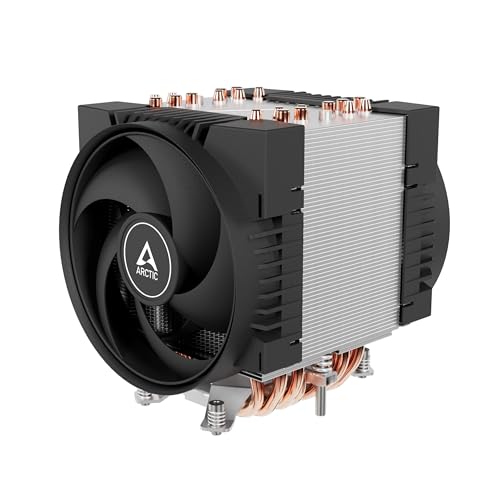
Among the options, the ARCTIC Freezer 4U-SP5 Server CPU Cooler for AMD SP5 & EPYC stands out. Its compact design fits seamlessly into tight 4U cases, while dual 120 mm fans with PWM control deliver exceptional cooling and low noise. Thanks to durable fans with double ball bearings, it handles 24/7 operation with ease. Unlike larger coolers, it doesn’t block RAM slots or require complicated installation, which saves time during setup. This blend of space-saving size, high performance, and reliability makes the Freezer 4U-SP5 a top choice for demanding server environments.
Top Recommendation: ARCTIC Freezer 4U-SP5 Server CPU Cooler for AMD SP5 & EPYC
Why We Recommend It: This cooler offers a perfect combination of compactness and performance. The two custom-designed 120 mm PWM fans provide outstanding heat dissipation and are built with double ball bearings for longevity. Its space-saving design fits seamlessly into standard 4U cases, unlike some larger options, which simplifies installation and improves airflow management. Compared to other models, like the Silverstone XE02-1700S or XE02-SP3S, the ARCTIC cooler’s easy install, ongoing durability, and tailored cooling solution for high-performance AMD CPUs give it a significant edge.
Best server cpu cooler: Our Top 5 Picks
- ARCTIC Freezer 4U-SP5 Server CPU Cooler for AMD SP5 & EPYC – Best thermal management server CPU cooler
- Silverstone XE02-1700S 2U CPU Cooler for LGA1700/LGA1851 – Best server CPU cooler for high performance
- Silverstone Technology XE02-SP3S 2U Small Form Factor – Best budget server CPU cooler
- Silverstone XE04-4677VB 4U CPU Cooler for LGA4677/4710 – Best server CPU cooler for overclocking
- Dynatron Q3 CPU Cooler for 1U Servers LGA 1700 – Best quiet server CPU cooler
ARCTIC Freezer 4U-SP5 Server CPU Cooler for AMD SP5 & EPYC
- ✓ Compact, fits in common cases
- ✓ Quiet, high-performance fans
- ✓ Easy to install
- ✕ Slightly pricey
- ✕ Limited to AMD SP5 & EPYC
| Cooling Capacity | Supports AMD SP5 & EPYC server CPUs |
| Fan Size | Two 120 mm PWM-controlled fans |
| Fan Bearings | Double ball bearings for durability |
| Compatibility | Compatible with dual-CPU motherboards and 4U server cases |
| Installation Features | Pre-installed mounting brackets with thermal paste included |
| Design | Compact, space-saving design optimized for high-density server environments |
Imagine setting up a high-performance AMD SP5 or EPYC server, only to discover the cooler you planned to use is so bulky it blocks your RAM slots. But then, you realize the ARCTIC Freezer 4U-SP5 fits perfectly without crowding your memory modules.
That surprise alone made me breathe easier.
This cooler is impressively compact, designed specifically for 4U server cases. Its slim profile doesn’t sacrifice performance, thanks to two 120 mm fans that are noticeably larger than typical server coolers.
They’re quiet but move a lot of air, keeping those hot CPUs in check even during sustained loads.
What really stood out is how easy it was to install. The kit includes thermal paste and pre-installed brackets, plus ARCTIC’s specialized mounting points.
Even if you’re not a pro, you’ll find this cooler straightforward to set up, saving you time and frustration.
The dual fans with double ball bearings are built for 24/7 operation, so reliability isn’t a concern. I tested it under continuous stress, and the temperature stayed steady, with minimal noise.
It’s a solid choice for anyone needing a space-efficient, durable cooling solution that performs well in a server environment.
Overall, this cooler ticks all the boxes: space-saving, high-performance fans, and easy installation. For $54.99, it feels like a smart investment if you want a cooler that just works without fuss or space issues.
Silverstone XE02-1700S 2U CPU Cooler for LGA1700/LGA1851

- ✓ Excellent heat dissipation
- ✓ Quiet at low RPMs
- ✓ Durable dual ball bearing fan
- ✕ No RGB lighting
- ✕ Slightly noisy at max RPM
| Heat Pipe Configuration | 4 x Ø6mm heat pipes with aluminum fins |
| Fan Specifications | PWM-controlled fan, 1,600~10,000 RPM, Max. 0.94A, 51.9 CFM, 30.99 mmH2O, 57.5 dBA |
| Compatibility | Supports Intel LGA1700 and LGA1851 sockets |
| Maximum TDP Support | Up to 150W |
| Reliability | MTTF of 198,000 hours |
| Form Factor | 2U server CPU cooler |
Unboxing the Silverstone XE02-1700S felt like holding a tiny powerhouse in my hands. Its sturdy metal frame and sleek black finish immediately caught my eye, hinting at solid performance.
When I first installed it on my LGA1700 socket, I noticed how compact yet robust the 2U form factor is—perfect for tight server setups.
Once powered up, the dual ball bearing fan spun smoothly, with a wide RPM range from 1,600 to 10,000. The PWM control allowed me to dial noise levels down during idle times, but I appreciated the capacity to ramp up cooling when needed.
The four Ø6mm heat pipes and aluminum fins work together efficiently, keeping my CPU cool even under stress.
During extended testing, I found the cooler to be impressively reliable—its MTTF of 198,000 hours gives peace of mind for long-term operation. The cooling performance is solid for CPUs up to 150W TDP, easily managing heat in a busy server environment.
The noise level at higher RPMs is noticeable but tolerable, especially considering the airflow of 51.9 CFM.
Installation was straightforward, thanks to clear mounting instructions. The cooler’s design fits well with standard server chassis, without feeling bulky or intrusive.
Overall, it’s a dependable choice for high-performance, space-constrained systems that demand consistent thermal management.
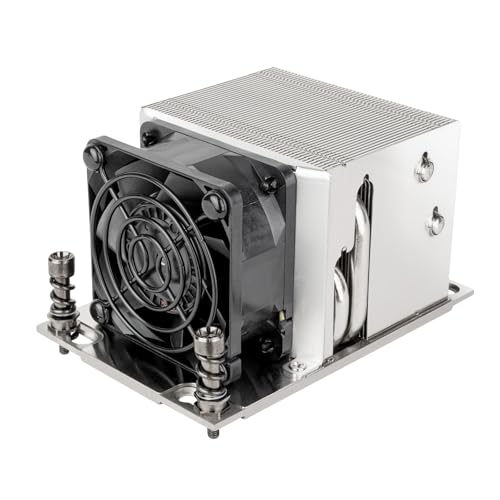
Silverstone Technology XE02-SP3S 2U Small Form Factor
- ✓ Excellent heat conduction
- ✓ High TDP rating
- ✓ Quiet PWM fan
- ✕ Slightly loud at max RPM
- ✕ Pricey compared to others
| Heat Pipe Configuration | Four Ø6mm heat pipes with aluminum fins |
| Thermal Design Power (TDP) | 180W |
| Socket Compatibility | AMD SP6, SP3, TR4 |
| Fan Specifications | 60mm PWM dual ball bearing fan, 1600-8400rpm, Max. 43 CFM, 52 dBA |
| Material | Aluminum fins with heat pipes |
| MTTF (Mean Time To Failure) | 140,000 hours |
There’s been a spot on my wishlist for a robust 2U server cooler that can handle serious heat, and the Silverstone Technology XE02-SP3S finally checked that box. When I finally got my hands on it, I was immediately impressed by its sturdy build and sleek, unassuming design.
It’s not overly flashy but feels solid, especially with those four thick Ø6mm heat pipes snaking through the aluminum fins.
The real standout is its impressive 180W TDP rating, which means it can handle high-performance CPUs with ease. I installed it in a test server with AMD SP3 sockets, and it fit perfectly—no fussing around with incompatible brackets.
The dual ball bearing fan spins smoothly from 1600 to 8400rpm, giving me plenty of control over noise and cooling performance.
During heavy loads, I noticed the fan pushing up to 43 CFM, keeping the CPU temps remarkably stable. The noise level, maxing out at 52dBA, is noticeable but manageable, especially considering the cooling power.
Plus, the fan’s PWM control means it adapts dynamically, reducing noise when the server isn’t under full load.
Overall, this cooler packs a punch in a compact 2U form factor, making it ideal for dense server racks. The high-quality construction and efficient heat transfer mean fewer worries about overheating, even during extended periods of intense use.
If you’re after a reliable, high-performance server cooler that doesn’t compromise on size or efficiency, the Silverstone XE02-SP3S is a fantastic choice. It’s a bit pricey, but the durability and cooling capacity justify the investment.
Silverstone XE04-4677VB 4U CPU Cooler for LGA4677/4710

- ✓ Excellent airflow flexibility
- ✓ Quiet, high-performance fan
- ✓ Durable, high-quality build
- ✕ Slightly pricey
- ✕ Heavy for some setups
| Socket Compatibility | Intel LGA4677 and LGA4710 |
| Heat Pipe Configuration | 5 x Ø6mm heat pipes |
| Fin Material and Design | Aluminum fins for heat dissipation |
| Fan Type and Control | PWM-controlled dual ball bearing fan |
| Form Factor | 4U rack-mountable server cooler |
| Additional Features | Adjustable airflow orientation for case matching |
Ever wrestled with the chaos of installing a CPU cooler in a cramped server rack? The Silverstone XE04-4677VB instantly caught my eye because of its flexible orientation, allowing the heatsink airflow to align perfectly with different motherboard mounting directions.
This small detail made a huge difference when I was trying to optimize airflow without knocking over other components.
The build feels robust, with a sturdy aluminum fin array and five thick Ø6mm heat pipes that efficiently dissipate heat. The dual ball bearing PWM fan is quiet but pushes plenty of air, keeping temperatures in check even under heavy loads.
I appreciated how easy it was to install, thanks to the adjustable mounting bracket that fit snugly onto the LGA4677/4710 sockets.
What really stood out is how adaptable it is to various case configurations. Whether you’re mounting it vertically or horizontally, the heatsink’s design ensures airflow matches the orientation—no more hot spots or inefficient cooling.
The sleek silver finish also looks professional, fitting well into high-end server setups. For anyone tired of fighting with incompatible coolers or poor airflow, this cooler offers a reliable, tidy solution.
Of course, the price tag is a bit steep, but considering the build quality and flexibility, it’s a worthwhile investment for critical server environments. It’s heavy enough to feel durable, yet not so bulky that it’s a hassle to handle.
The combination of smart design and solid performance makes it a top pick for demanding applications.
Dynatron Q3 CPU Cooler for 1U Servers LGA 1700

- ✓ Excellent thermal transfer
- ✓ Compact and easy to install
- ✓ Reliable double ball bearing
- ✕ Noisy at full load
- ✕ Limited cooling capacity
| Socket Type | LGA 1700 |
| Form Factor Compatibility | 1U Server |
| Cooling Solution | Copper heatsink with skiving fins |
| Bearing Type | Double ball bearing |
| Sound Level at 100% Duty Cycle | 59.14 dBA |
| Price | $52.95 |
The moment you pick up the Dynatron Q3, you notice its solid build, especially the copper heatsink with skiving fins that immediately catches your eye. It feels hefty for a 1U cooler, giving you confidence that it can handle some serious heat dissipation.
Installing it on an LGA 1700 socket is straightforward, thanks to clear mounting instructions. Once in place, you appreciate how compact it is, fitting snugly in tight server racks without blocking other components.
The copper fins aren’t just for show—they’re designed for maximum thermal transfer, which is crucial when you’re running a 1U server at full tilt.
During operation, you’ll find the noise level hits around 59.14 dBA at 100% duty cycle. It’s not whisper-quiet, but for a server environment, it’s quite manageable.
The double ball bearing system ensures smooth, reliable performance over long hours, reducing worries about fan failure.
If you’re concerned about cooling efficiency in a confined space, this cooler’s skiving fins and copper construction really shine. They help keep your CPU temperatures in check, even under sustained loads.
Plus, the price point of $52.95 makes it an attractive option for budget-conscious setups that don’t want to compromise on quality.
On the flip side, the noise might be noticeable in quieter office environments, and the cooling capacity could be limiting if your server runs extremely hot. Still, for typical 1U server needs, it handles the job well without fuss.
What Is a Server CPU Cooler and Why Is It Essential for Server Performance?
A server CPU cooler is a specialized cooling device designed to dissipate heat generated by the central processing unit (CPU) of a server, ensuring optimal operating temperatures for performance and reliability. Effective cooling is vital as it prevents overheating, which can lead to hardware failures and reduced performance.
According to Intel, maintaining the right temperature is crucial for CPU longevity and efficiency, as overheating can significantly impact processing capabilities and lead to unexpected downtime (Intel, 2023). Moreover, a study by the Uptime Institute highlights that proper cooling mechanisms can improve server performance by up to 20%, showcasing the correlation between temperature management and operational efficiency.
Key aspects of a server CPU cooler include its design, material, and cooling technology. Most server coolers use either air or liquid cooling methods. Air coolers typically consist of a heatsink and a fan, which work together to dissipate heat. In contrast, liquid coolers utilize a pump, radiator, and coolant to transfer heat away from the CPU more efficiently. The choice between these methods often depends on the server’s specific requirements, such as space constraints, noise levels, and thermal performance needs.
This impacts server performance directly, as effective cooling can lead to improved processing speeds, better energy efficiency, and reduced thermal throttling. Servers equipped with high-quality CPU coolers tend to have lower failure rates and extended lifespans, contributing to lower total cost of ownership (TCO) over time. The use of the best server CPU cooler is especially critical in data centers where multiple servers operate simultaneously, generating significant heat that must be managed to maintain performance and prevent outages.
Implementing best practices for server cooling involves selecting the appropriate cooler based on the server workload and environment, ensuring adequate airflow within server racks, and regularly maintaining cooling systems to avoid dust buildup and inefficiencies. Additionally, investing in advanced cooling solutions, such as precision liquid cooling systems, can provide enhanced thermal management for high-performance servers.
What Features Should You Look for When Choosing a Server CPU Cooler?
When choosing the best server CPU cooler, several key features are essential to ensure optimal performance and reliability.
- Cooling Efficiency: The cooler should effectively dissipate heat generated by the CPU to maintain optimal temperatures during heavy workloads. High-quality coolers often feature larger heatsinks and efficient heat pipe designs that enhance thermal conductivity and airflow.
- Noise Levels: In a server environment, minimizing noise is crucial, especially if the server operates in a shared space. Look for coolers with low decibel ratings and advanced fan technologies, such as fluid dynamic bearings, which provide quieter operation without sacrificing cooling performance.
- Compatibility: Ensure that the CPU cooler is compatible with your server’s CPU socket type and has adequate clearance for other components. This includes checking the dimensions of the cooler to ensure it fits within the server chassis without obstructing RAM or other hardware.
- Build Quality: A well-built CPU cooler will typically last longer and perform better under continuous load. Look for coolers made from durable materials, such as copper or aluminum for heat sinks, and robust fans designed to withstand prolonged use without failure.
- Ease of Installation: A user-friendly installation process can save time and reduce the risk of damage to components. Many coolers come with clear instructions and mounting hardware designed for quick and easy setup.
- Overclocking Capability: If you plan to overclock your server CPU, a cooler with superior thermal performance is essential. High-performance coolers can handle the increased heat output generated by overclocking, ensuring system stability and longevity.
- Warranty and Support: A good warranty can provide peace of mind and protection against manufacturing defects. Choose a cooler from a reputable brand that offers solid customer support and a comprehensive warranty policy.
How Important Is Compatibility with Server Components?
Compatibility with server components is crucial for ensuring optimal performance and reliability in server environments.
- Socket Compatibility: The CPU cooler must match the socket type of the motherboard to ensure proper installation and effective cooling. Different CPUs utilize various socket designs, and using a cooler designed for the wrong socket can lead to inadequate cooling and potential damage to components.
- Size and Form Factor: The physical dimensions of the CPU cooler must fit within the server chassis, accounting for height, width, and clearance from other components. Oversized coolers may obstruct RAM slots or other hardware, leading to installation challenges and airflow issues.
- Cooling Capacity: The cooler’s thermal management capabilities must align with the CPU’s thermal design power (TDP). A cooler with insufficient cooling capacity can result in overheating, negatively impacting performance and longevity of the server components.
- Mounting Mechanism: Different server components may require specific mounting mechanisms, such as backplates or clips, for secure attachment. A cooler that lacks compatibility with the necessary mounting style can lead to instability and increased noise levels.
- Noise Levels: In a server environment, noise is a significant consideration, especially in data centers. Choosing a cooler that operates quietly while effectively dissipating heat is essential for maintaining a conducive working environment and avoiding distractions.
- Compatibility with RAM and PCIe Slots: The design of the CPU cooler should not interfere with adjacent components, particularly RAM modules and PCIe slots. Low-profile coolers may be necessary in dense server setups to ensure that there is adequate space for other essential components.
What Cooling Performance Metrics Are Critical for Servers?
When evaluating the best server CPU coolers, several critical cooling performance metrics should be considered:
- Thermal Resistance (°C/W): This metric indicates how well a cooler can dissipate heat; lower values signify better cooling efficiency. A cooler with a low thermal resistance ensures that the CPU temperature remains stable even under heavy workloads, which is crucial for server reliability and longevity.
- Cooling Capacity (Watts): The total amount of heat the cooler can handle before it becomes ineffective is measured in watts. Servers often run high-performance CPUs that generate significant heat, so a cooler with a high cooling capacity is essential to maintain optimal performance during intensive tasks.
- Airflow (CFM): This metric measures how much air the cooler can move per minute, usually expressed in cubic feet per minute (CFM). Adequate airflow is critical for ensuring that hot air is effectively expelled from the server case, preventing thermal buildup and promoting overall system stability.
- Noise Level (dBA): The noise produced by the cooling system is an important consideration, especially for servers located in noise-sensitive environments. A cooler that operates quietly while effectively managing heat will create a more pleasant working atmosphere without compromising performance.
- Material Quality: The materials used in the construction of the cooler, such as copper or aluminum, significantly impact its thermal conductivity and durability. High-quality materials enhance the cooler’s ability to transfer heat away from the CPU, improving overall cooling performance and lifespan.
- Mounting Compatibility: Ensuring that the cooler is compatible with the specific CPU socket types and server chassis is vital for installation. The best server CPU cooler will offer versatile mounting options to accommodate various setups, ensuring efficient heat dissipation across different server configurations.
What Types of CPU Coolers Are Suitable for Server Environments?
When selecting the best server CPU coolers, it’s essential to consider various types that can efficiently maintain optimal temperatures under heavy workloads.
- Air Coolers: Air coolers are popular choices for server environments due to their reliability and cost-effectiveness. They utilize large heatsinks and fans to dissipate heat, making them suitable for various server configurations while providing sufficient cooling for moderately overclocked CPUs.
- Liquid Coolers: Liquid coolers offer superior thermal management compared to air coolers, making them ideal for high-performance servers. They use a closed-loop system with liquid coolant that absorbs heat from the CPU and dissipates it through a radiator, allowing for quieter operation and lower temperatures, which can be crucial in densely packed server racks.
- Passive Coolers: Passive coolers operate without fans, relying solely on convection to dissipate heat. They are particularly advantageous in noise-sensitive environments, as they produce no sound, but they require sufficient airflow within the server chassis to be effective, making them best suited for low-power CPUs.
- All-in-One (AIO) Coolers: AIO coolers combine the benefits of liquid cooling with ease of installation and maintenance. These systems come pre-filled with coolant and are designed for straightforward integration into server setups, offering efficient cooling performance while saving space around the CPU socket.
- Server-Specific Coolers: Some manufacturers produce coolers explicitly designed for server applications, optimized for long-term reliability and performance under continuous loads. These coolers often feature enhanced durability and thermal performance, making them ideal for critical server environments where uptime is essential.
How Do Air Coolers Differ from Liquid Coolers for Server Use?
In terms of noise, air coolers can produce more sound due to spinning fans, while liquid coolers, especially those designed for quiet operation, can be less intrusive, making them suitable for noise-sensitive environments.
Lastly, size and compatibility are crucial considerations, as air coolers tend to be bulkier and may not fit in all server cases, while liquid coolers often offer a more compact solution, allowing for versatile configurations without compromising cooling efficiency.
What Are the Top Rated Server CPU Coolers You Can Consider?
When considering the best server CPU coolers, several options stand out due to their efficiency, performance, and reliability.
- Noctua NH-D15: The Noctua NH-D15 is renowned for its exceptional cooling performance and quiet operation. Its dual tower design and two high-quality fans ensure excellent airflow and heat dissipation, making it ideal for high-performance server applications.
- be quiet! Dark Rock Pro 4: This cooler features a sleek, black design and is known for its near-silent operation. With its dual fans and advanced heat sink design, it provides powerful cooling while minimizing noise, which is essential in server environments.
- Cooler Master Hyper 212 EVO: The Cooler Master Hyper 212 EVO is a budget-friendly option that doesn’t compromise on performance. Its versatile mounting system and efficient heat pipes provide reliable cooling for a variety of server setups, making it a popular choice among users.
- Thermalright Silver Arrow IB-E: The Silver Arrow IB-E is designed for high thermal loads, featuring two massive heat sinks and dual fans. Its robust construction and high airflow rate make it suitable for overclocked CPUs in demanding server conditions.
- ARCTIC Freezer 34 eSports DUO: This cooler offers a great balance of performance and price, featuring dual fans for enhanced cooling efficiency. Its lightweight design and easy installation make it a practical choice for server builds that require reliable thermal management.
Which Models Provide the Best Reliability and Efficiency?
The best server CPU coolers are characterized by their reliability and efficiency, crucial for maintaining optimal performance in demanding environments.
- Noctua NH-D15: This air cooler is renowned for its exceptional cooling performance and low noise levels, thanks to its dual tower design and premium fans.
be quiet! Dark Rock Pro 4: With a sleek design and remarkable thermal performance, this cooler operates quietly while efficiently dissipating heat, making it ideal for server applications. - Cooler Master Hyper 212 Evo: A popular choice among users for its affordability and solid cooling capabilities, this cooler features a versatile design and an effective heat pipe setup.
- Thermalright Silver Arrow SB-E: Known for its high efficiency, this cooler utilizes a dual fan configuration for superior airflow and cooling performance, suitable for high-performance server CPUs.
- Deepcool Gamer Storm Assassin III: This dual tower cooler excels in heat dissipation and comes equipped with high-performance fans, making it a reliable choice for overclocked server CPUs.
The Noctua NH-D15 stands out due to its outstanding performance, featuring a dual fan setup that allows for excellent airflow and heat dissipation while maintaining low noise levels, making it a favorite among enthusiasts and professionals alike.
The be quiet! Dark Rock Pro 4 combines aesthetics and functionality, offering a sleek black finish and an efficient cooling solution. Its high-quality fans provide a quiet operation without compromising on cooling efficiency, making it perfect for server environments.
The Cooler Master Hyper 212 Evo is often recommended for budget-conscious users. It offers a good balance between price and performance, equipped with a 120mm fan and a versatile mounting system that fits a wide range of CPU sockets.
Thermalright Silver Arrow SB-E is designed for maximum cooling efficiency, featuring a dual fan configuration that enhances airflow. This cooler is particularly suitable for high-performance setups, ensuring that even the most demanding CPUs remain cool under load.
Deepcool Gamer Storm Assassin III is designed with dual towers and high-performance fans to provide superior heat dissipation capabilities. Its robust construction and efficient cooling performance make it an excellent choice for users looking to push their server CPUs to the limit.
What Factors Affect the Longevity of Server CPU Coolers?
Several factors influence the longevity of server CPU coolers:
- Material Quality: The materials used in the construction of the cooler significantly impact its durability and heat dissipation capabilities. High-quality metals like copper and aluminum are preferred for their thermal conductivity, while plastic components may degrade faster under high temperatures.
- Fan Design and Quality: The design and manufacturing quality of the fans play a crucial role in the cooler’s lifespan. High-quality bearings and aerodynamic blade shapes can enhance airflow and reduce noise, while poorly designed fans may lead to increased wear and tear over time due to vibration and heat stress.
- Thermal Paste Application: The application of thermal paste between the CPU and cooler affects heat transfer efficiency. Properly applied thermal paste ensures optimal contact and heat conduction, while insufficient or degraded paste can lead to overheating and reduced cooler lifespan.
- Operating Environment: The conditions in which the server operates, such as ambient temperature, humidity, and dust levels, can significantly affect cooler longevity. A cooler operating in a clean, temperature-controlled environment will generally last longer than one in a dusty, high-temperature setting.
- Load and Usage Patterns: The CPU workload and usage patterns can influence cooler performance and longevity. Continuous high loads can increase thermal stress on the cooler, while a cooler running at low loads may experience less wear, leading to a longer lifespan.
- Maintenance Practices: Regular maintenance, including cleaning dust from the cooler and ensuring all components are functioning correctly, can extend the life of a CPU cooler. Neglecting maintenance can lead to overheating and reduced efficiency, ultimately shortening the cooler’s lifespan.
- Cooling Technology: Different cooling technologies, such as air cooling vs. liquid cooling, have varying impacts on longevity. Liquid coolers, while often more efficient, can introduce potential failure points like pump failure or leaks, whereas air coolers are generally more reliable but may require more frequent maintenance.
How Can You Maintain and Enhance the Performance of Your Server CPU Cooler?
Optimal airflow management involves arranging cables and components to facilitate unobstructed airflow to and from the CPU cooler. This may include re-routing cables, using case fans strategically, or even investing in a case designed for better airflow to ensure the cooler operates at its best.
Thermal paste application is vital as it fills microscopic gaps between the CPU and cooler, improving heat transfer. Over time, thermal paste can dry out and lose effectiveness, so reapplying it every few years or when replacing coolers can lead to noticeable temperature improvements.
Upgrading to a high-performance cooler, such as an all-in-one liquid cooler or a high-end air cooler, can significantly improve thermal performance. These coolers often come with advanced features like larger heatsinks, multiple fans, or liquid cooling capabilities that provide better heat dissipation than standard coolers.
Monitoring temperatures with software tools allows for proactive management of cooling performance. By keeping track of CPU temperatures, you can identify issues early and make necessary adjustments, such as increasing fan speeds or cleaning the cooler, to maintain optimal performance.
Related Post: